"Honourable men go with honourable men."
After crafting two very different, distinct yet ultimately
fairly substandard films, it’s safe to say that Martin Scorsese wasn’t exactly
on anyone’s radar as 1973 arrived. That proved to be a grave miscalculation as
in October of that year he arrived in the scene with his first true
masterpiece. ‘Mean Streets’ proved to be energetic, powerful and deeply
personal.
Charlie (Harvey Keitel) is a young Italian-American man who
is trying to move up in the local New York Mafia but is hampered by his feeling
of responsibility towards his reckless younger friend Johnny Boy (Robert De
Niro), a small-time gambler who owes money to many loan sharks. This film
chronicles their efforts to navigate the dangerous world they inhabit and try
to satisfy their raging ambition.
Like all of Scorsese’s great movies, ‘Mean Streets’ is so
much deeper and more complex than it would suggest, transcending the
limitations of its genre and becoming something much more profound. ‘Taxi
Driver’ is more than just a thriller, ‘Raging Bull’ is not simply a sports
movie and ‘Mean Streets’ is far from another gangster flick. It’s not about
gangsters, it’s about the state of sin and the concept of guilt and the effects
of growing up in a gangster environment.
These themes are shown perfectly by the films two main
characters. As Charlie Keitel plays a man with a pathological guilt complex,
one who continues to carry out acts of violence only to beg and pray for forgiveness.
In one famous shot he holds his hand above a candle in the alter and tries to
keep it their despite the obvious pain, almost as if he is trying to prepare
himself for the fires of hell. But despite this he never quite forces himself
to quit the business.
 His friend Johnny Boy on the other hand is in many ways the
complete opposite. Where Charlie represses his anger so it haunts him
internally, Johnny releases it regularly much to the inconvenience of everyone
around him, especially Charlie. He struts through life with what could be
mistaken for no sense of self preservation, he shoots out street light when he’s
bored, borrows money from loan sharks and picks fight with people over insults
he doesn’t even understand. He is violent and uncontrollable but one has to
wonder, as Scorsese subtly asks it throughout the picture, is he just a product
of the world around him?
His friend Johnny Boy on the other hand is in many ways the
complete opposite. Where Charlie represses his anger so it haunts him
internally, Johnny releases it regularly much to the inconvenience of everyone
around him, especially Charlie. He struts through life with what could be
mistaken for no sense of self preservation, he shoots out street light when he’s
bored, borrows money from loan sharks and picks fight with people over insults
he doesn’t even understand. He is violent and uncontrollable but one has to
wonder, as Scorsese subtly asks it throughout the picture, is he just a product
of the world around him?
It’s difficult not to answer yes, because that world is so thoroughly
fleshed out by Scorsese and brought to life with such brilliance. From the
first shot there’s a sense of imminent danger, frustration, pent up anger as if
the whole situation might suddenly explode. I know of no other director who can
blend grittiness with style as brilliantly as Scorsese and ‘Mean Streets’ is a
prime example of that. Just one example is that the real world is filmed in
ordinary colours but the bars and hideouts are lit in blood red, bathed in
violence, anger and danger. The varying speeds, altered angles and pitch
perfect use of music give the film such a sense of vibrancy and energy.
You would think that balancing a study of an environment
with two character studies would be impossible but think again. Both Johnny and
Charlie are performed so perfectly by De Niro and Keitel that choosing between
them is near impossible. For one the prime motive is self-loathing and for the other,
self-destruction. One believes solely in his religion and cannot do anything in
life without being a sinner. Charlie craves redemption yet has no idea how to
obtain it, so for now all he can do is go on surviving the only way he knows
how. Johnny possesses an over romanticised view of criminals and seems to think
he’s in a gangster movie. When we first meet him he plants an explosive in a
mailbox and watches as it blows up. Why? Boredom.
You would think that with such an emphasis on character and
environment there wouldn’t be much to the action scenes. But once again you
would be wrong. Scorsese utilised hand held camera for quick movement and
fights, moving the viewer’s vision nimbly through the continually erupting chaos.
Despite the eloquence the fights retain their sense of grit and realism. The
characters do not suddenly become expertly trained fighters, they are still
young punks practising whatever fight moves they saw in a movie.
‘Mean Streets’ proved to be Scorsese’s first breakout
success and what made that all the more remarkable was how miniscule its budget
was. The actors involved had little experience and while it should be set in
New York, most of it is shot on the disguised streets of L.A. In many ways that’s
why it’s so brilliant, you never feel as if you’re watching actors or stages,
you’re watching real life unfold right in front of you, life with all the pain,
violence and tragedy.
Stylish, personal and thematic but also gritty, provocative
and endlessly enthralling.
Result: 10/10




 That shot also harkens back to Gareth Edwards talent for
scale. One of the things I admired the most about his ‘Godzilla’ remake was the
way in which he gave such a sense of size, scope and weight to the monster and
he did the same thing in his micro-budget debut ‘Monsters’ and it’s the same
thing here in this shot. Another place in which it is visible is the slow
reveal of the Death Star, clearly under the final stages of its construction,
menacingly dwarfing a group of Star Destroyers. In fact those Star Destroyers
on their own are fantastic, the CGI is absolutely implacable and completely
indistinguishable from the real models used in the original trilogy.
That shot also harkens back to Gareth Edwards talent for
scale. One of the things I admired the most about his ‘Godzilla’ remake was the
way in which he gave such a sense of size, scope and weight to the monster and
he did the same thing in his micro-budget debut ‘Monsters’ and it’s the same
thing here in this shot. Another place in which it is visible is the slow
reveal of the Death Star, clearly under the final stages of its construction,
menacingly dwarfing a group of Star Destroyers. In fact those Star Destroyers
on their own are fantastic, the CGI is absolutely implacable and completely
indistinguishable from the real models used in the original trilogy.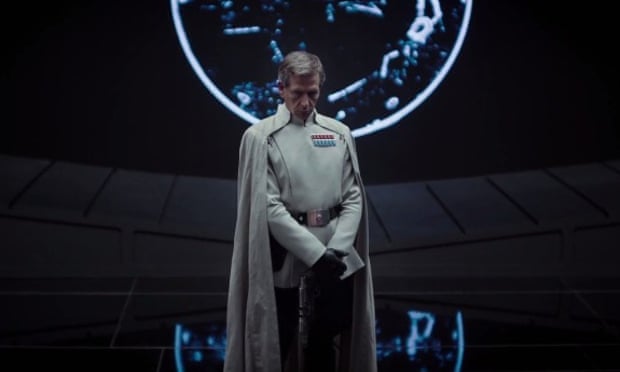 A number of brief character introductions instantly peaked
my curiosity such as Donnie Yen’s Samurai-like Rebel or Forrest Whitaker’s war
weary veteran and especially Ben Mendelson’s Imperial … what, general? Inquisitor?
Grand Admiral? I can’t wait to find out. But of all of them I was deeply
impressed by the introduction to Felicity Jones’ character Jyn Erso. Sadly some
less than educated folk have already complained about the fact that a ‘Star
Wars’ movie is set to debut its second female lead (god forbid a ‘Star Wars’ movie
have a strong female character!). Honestly though there are currently seven
films in this franchise and when you think about the gender ratio of each lead
it currently stands at 6 to 1, I think we can afford to have another.
A number of brief character introductions instantly peaked
my curiosity such as Donnie Yen’s Samurai-like Rebel or Forrest Whitaker’s war
weary veteran and especially Ben Mendelson’s Imperial … what, general? Inquisitor?
Grand Admiral? I can’t wait to find out. But of all of them I was deeply
impressed by the introduction to Felicity Jones’ character Jyn Erso. Sadly some
less than educated folk have already complained about the fact that a ‘Star
Wars’ movie is set to debut its second female lead (god forbid a ‘Star Wars’ movie
have a strong female character!). Honestly though there are currently seven
films in this franchise and when you think about the gender ratio of each lead
it currently stands at 6 to 1, I think we can afford to have another.