Translate

Monday, 16 March 2015

An Introduction to The Relatables

Sometimes a certain film comes out and you can’t help but think ‘I’ve seen that before’ and it can be true. More than ever, especially in recent years, with reboots, remakes and reimagining’s you get films that share several qualities with some that come before it and rather than borrow the things that work, they try to distance themselves from the original.
A sad example of this is what happened to the Amazing Spider Man. They were so desperate to separate themselves from the Sam Raimi trilogy that they went as far as to cut out Uncle Ben’s most important line. But at the same time they had to follow the same plot points and had no way of reimagining them, therefore it just felt like a cheap copy of the original that didn’t want to be noticed by fans of Toby Maguire and called out because of it, like a Youtube video that tries not to get to many views rather than risk copyright infringement.   
So sometimes it can be a good idea to copy the original version in some respects. But of course it can prove disastrous as seen with Psycho, completely failing to grasp artistic beauty of the original and the nerve shredding suspense. The reason was firstly the lack of substance, and the lack of originality. The film was only twenty years old at the time of the remake, it’s like someone remaking Pulp Fiction today, but at the same time we knew that story, we knew what would happen, Psycho wasn’t like a foreign language film and not accessible to the masses of western audiences, the box office numbers of the original proved that. If the writers had somehow found a way to retell that story then t might have succeeded in gripping audiences.
But as I said, sometimes films are just similar, without being a remake and rather than call them out for it, we should encourage them to do it but in their own new way. At the same time of course they could learn a lot from the original inspiration.

So this series covers everything that separates one good film from a terrible one. I’ll highlight what it should have used and what it did on its own to its advantage as well as why one succeeded and one didn’t. So get ready for the Relatables. 

Saturday, 14 March 2015

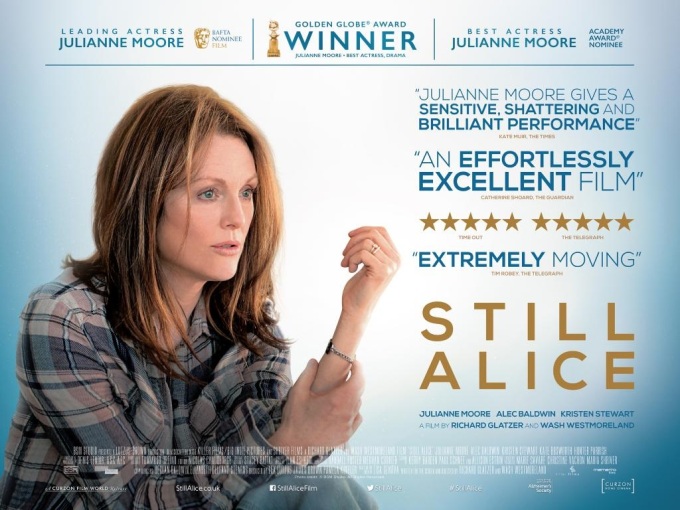
Still Alice

"I can see the words hanging in front of me and I can't reach them and I don't know who I am and I don't know what I'm gonna loose next."

It’s safe to say that Julianne Moore has been massively successful on nearly every level of her career. Just to give one example, she’s arguably the standout of PT Anderson’s Magnolia, a film that features Tom Cruise, Phillip Seymour Hoffman, William H Macy and John C Reilly. And that was just a supporting role. Here she takes up the lead role to give one of the most beautiful and haunting performances of recent memory.
A linguistics professor Alice Howland (Moore) who has recently turns fifty and is happily married as well as being a mother of three suddenly has her life turned upside down when she begins to suffer from memory lapses. These symptoms are diagnosed as early signs of Alzheimer’s disease and now she has to try and retain her own identity and memories.
There’s also no denying that this film was always going to raise delicate subjects. Moore’s performance has to cover many things here, as well as the various stages of the disease she gives us a picture of a proud and intelligent woman. These early impressions that she expertly exudes only make it more heart-breaking as her mind itself is compromised. It’s also a very subdued portrayal of the character, diving straight into the role but not to the extent of being flashy and over the top. It’s quiet for a majority of the film, and that’s what makes it so spectacular in its own way.
While it’s rare for this disease to affect someone this young it’s not unheard of. Here we see a bleak version of events and the repercussions from almost every angle. Not only is there the issue of her own mind decaying, but there’s a 50/50 chance that her children will inherit the disease from her as well. The tragedy of it is highlighted as Alice could not have seen this coming, as her own mother dies when she was young.
The family that surrounds her are also portrayed expertly and combined with the excellent writing they do feel genuine. Alec Baldwin as Alice’s husband John is a prime example. Too many films with a similar premise involve the spouse leaving their partner as they encounter difficulties. Here Baldwin stays with her throughout and is supportive, like a genuine person who cares and will do what someone who loves a person would do. This is also the best performance I’ve ever seen from Kristen Stewart.
There’s a great precision and sensitivity to this screenplay as well. There are very few false steps and because the majority is so good one could almost forgive it for those few times that it does. But it does occasionally, for a start there are some repetitive moments in the film, and I understand that it does need to create that effect to hammer the message across, but sometimes it feels as if they’re using a sledgehammer to do it. There’s also one oddly redundant scene in which Stewart’s character performs a Chekov play).
But I am nit-picking here. It would be easy to forget, amid the amazing performances, that there are also some impressive directorial techniques on display here from Wash Westmoreland and Richard Glatzer. The use of spinning cameras and blurred images make the deterioration of Alice’s brain a cinematographically impressive spectacle. As the film, and the condition, progresses these effects also progress in a similar fashion, just in case you had any doubts over the severity of this situation.
The end of this film is also emotionally ambiguous, not to give anything away. I do love a film that has the confidence to not manipulate the viewer over what to feel at the end, instead you can decide what emotional level the end result of Alice’s journey reaches.
So not only is this the performance of Julianne Moore’s career but it also proves to be emotionally resounding and deeply thoughtful thanks to an incredible screenplay and interesting direction.
Result: 9/10

Tuesday, 10 March 2015

Focus

"Congratulations, you're a criminal."

A lot of critics claim that Will Smith hit his commercial peak in the 1990s with Independence Day and Men in Black. Then he hit a dramatic peak in the early 2000s with Ali and The Pursuit of Happiness. Recently though, few will deny that he has taken a slight downturn, not around nearly as much as we’ve previously seen him and not in any successful films critically or commercially. With DC’s Suicide Squad only a year away (compared to a lot of the films scheduled that’s very recent) it might be a good time to make a return to the top billing, has he done it here?
A veteran conman (Smith) takes rookie thief (Margot Robbie) under his wing to teach her the ways of his trade. However, when they individually become involved in a major racing heist one wrong turn from just one of them could spell disaster for both of them.
For those of you hoping to see Will Smith in a role that allows him to display some charisma with the necessary dramatic depth to make him stand out in that usual way that he does, then you will not be disappointed. He does have some great on screen chemistry with Robbie in which they complement each other whilst also establishing an interesting character within. The dialogue is well written and performed brilliantly by the two leads, if you want some idea of what they will be like in Suicide Squad then the chances are that it will be like this as it seems to be a good formula and suits their style.
Speaking of style in general, Focus has a lot of it. There’s a lot of glitz and glamour on display to add to the film. It certainly looks like a good con film based on aesthetics at least. Assisted by some brilliant cinematography and lighting the film succeeds in avoiding that flavourless and dreary vibe that Smith fell into otherwise known as After Earth.
I do take issue with the structure of the film though. While singularly the segments are all entertaining and enthralling, the film feels like it’s been split into two sections rather lazily. It features Smith training his newest asset and then of course they enter a new heist, but the training segment takes up half of the film that really isn’t needed, or at least should not be presented in that structure. If they had started off in the big heist then use flashbacks to show the training or abandon the small heist and instead break up the training with some smaller cons in a more episodic fashion then I would be much happier with the overall story.
The reason why Focus would suit a flashback scenario is because I was actually interested in both parts, usually in films with flashbacks I’m much more interested in one aspect than in another, but here I would have loved both parts equally and wanted to explore them both at the same time and to give the movie a pleasing structure.
As well as this the emotional centre of the film is off slightly. Since she is the novice one would think that Robbie is the emotional attachment for the audience, and since he is the wise and all-knowing master Smith should be a supporting character, but instead Focus’ core darts in between them throughout, as if it’s unaware of who to actually concentrate on.
As well as this, as too many heist films eventually do, Focus jumps the shark a bit with its final twist. I can’t really spoil it and I doubt you’ll see it coming because it is rather farfetched in that respect. And as well as this, I can’t help but think to myself that Focus is much more of a quick time killer of a movie rather than something you’d remember for more than a year.
Perhaps too light hearted to be the heavy hitting drama it was advertised as and not quite comedic enough to be classed as a humorous take on the genre Focus feels a bit unfocussed (ironically) but rest assured it is very entertaining.
Result: 6/10 

Monday, 9 March 2015

CHAPPiE

Image result for chappie poster

"I am consciousness, I am alive, I am Chappie."

Director Neil Blomkamp has been praised as the latest addition to a string of legendary science fiction visionaries. His first big success District 9 was a success in every word, even being nominated for Best Picture at the Oscars, his next film Elysium was slightly more divisive, looked upon favourably by most and as mediocre by others (myself included). But both boasted interesting stories and amazing visual effects. Chappie restores the universal balance by being disliked by nearly everyone (myself included).
In the near future police droids known as scouts are used on a mass scale by the government to maintain order. But, not content with his success their creator decides to work on a machine that can think and make decisions independently in the same way that a human can. However the company does not take kindly to his actions such as rival inventor (Hugh Jackman) who decide to take action against his creation, or as he has called it, Chappie.
One thing that must be immediately praised about Chappie is, well, Chappie. The titular character is wonderfully innovative and essential to the story as it progresses. From the machine we see development, comedy and all the backstory to make it a compelling character.
However this is ruined by the fact that the child like Chappie is taken in by criminal and becomes one, not as the trailer made us believe a robot that gets most of his morals from Saturday morning cartoons (like we did, am I right… no… just me then). Executed in the right way the criminal story could still emotional. But it isn’t so you almost loose sympathy for the most likable and well developed character in the film.
Though Chappie is aesthetically pleasing, with some truly spectacular special effects work and great interaction between the physical and the CGI aspects of the story, it has many, many flaws. The first of which is the characters and the way they are written. Hugh Hackman brings no distinctive or unique feel to the story’s main villain. Though he talks briefly about the ethics of robotics aside from that all of his actions are made without any justification or explanation. If he’s just in it the money then why doesn’t he just say that instead of –arsed monologue about robotic laws? If there’s something else behind it why is there no explanation.
The creator of the robot is your usual young man with a dream cliché and has no real opinion other than to create something and then protect it, why, what’s his personal connection with the concept to risk his life in order to find it. The acting on display from some of the supporting cast is abysmal to say the least. As the cheerful robot is on the run he hangs out with a group of criminals and their contribution needed to be reduced here a lot. It is just bad full stop, not bad as in not caring or over enthusiastic, it’s just painful to watch them on screen.
The plot also feels sharply and roughly drawn towards a final shootout that, though it is fun and well directed, is inevitable. The rush and need to steer the film towards this throughout means that Chappie cannot answer the questions it promised it would raise. The grasp of the writing cannot cope with the big questions the concept raised. But in an effort to steer clear of Elysium Blomkamp has taken a more talkative story here, which would be fine if the acting and characters were actually good, but they aren’t. Elysium was criticised for choosing action over examination, Chappie actually has less excitement than District 9, but with characters that are not as interesting or examine a large concept from an intimate point of view.
Just thinking about it now it hit me, Chappie is could have been the mainstream and successful Brad Bird’s Iron Giant. If you were disappointed by the direction Chappie took then you should check out that and find a better story about AI reacting to humans.
If the trailer promised you a grown up ET, all Chappie gives you is an elitist Transformers.
Result: 3/10

Wednesday, 4 March 2015

It Follows

Image result for it follows poster

"Wherever you are it's somewhere walking straight for you. All you can do is pass it along to someone else."

Horror films are on a decline, there is no denying it. Even when audiences do get a genuine horror masterpiece like Oculus of the Babadook they end up disliking it because they’ve become so used to the generic , lazily written, cheap jump scares, money making, stupid characters, cliché ridden, unfrightening pieces of crap (god I hate those kind of horror movies) where was I? Oh yeah… that they give it a bad score, complaining about the monsters not appearing. It Follows may be the one that can do both, it could break that mould by tapping into the mainstream horror, only very slightly, and then putting a unique spin on it to be all things to all people.
Following teenager Jay’s (Makia Monroe) recent romantic evening that culminates in sleeping with her boyfriend, he reveals that he has passed a curse onto her. Something will follow her and torment her until she finds a way to pass the curse on to another unfortunate soul. Abandoned by the boy but assisted by her friends she must find a way to escape the supernatural stalker.
It Follows certainly harkens back to what many will refer to as the golden age of horror, the late 70s/early 80s era. Here you had everything from exploitation, slasher, psychological and demonic, your Elm Street’s, Exorcist’s, Shining’s and Halloween’s, all there for a fright night you’d never forget. And elements of them all are clearly visible in this film. It Follows takes them as inspiration, applies them to its own simple premise and plays with them a bit as well.
This can create problems, primarily the fact that if you know these films well enough you can see them being used and though it is great fun to watch them, it can be distracting and reduce the actual horror. For gullible teenagers this will undoubtedly be horrifying but be prepared to be disturbed rather than terrified if you a horror fanatic.
But in another way that can be beautiful because there’s more of a sense of dread rather than sheer terror. There’s a real sense that you’re stuck on a roller coaster with Jay that you can’t get off  and even though you desperately want to there’s still enough intrigue and mystery to make you stay on. This is only highlighted by the fact that the Follower only gives chase at walking speed, but it will never stop. This gradual chase is used to great effect, something just at the corner of the screen could be the final threat and the sense of paranoia it generates is brilliant. It Follows also clearly relishes these clichés as much as it examines them, similarly to Cabin in The Woods a few years ago.
Actually speaking of which there are a number of similarities as Cabin in the Woods is probably not the scariest of horror films, but it’s clever enough to be admired as something else and the masterful execution and no nonsense acting style from everyone involved really makes it stand out. The same goes for It Follows. Especially Monroe as she takes just the right approach to make me and everyone else sympathise and connect with Jay as she struggles through teenage life before becoming the possessor of an STD (but in this case D stands for demon) actually, you could look at this film as a subversive comment on STD’s just as people have done so with Cronberg’s The Fly. They act like real teenagers, they have complicated relationships but they don’t hate each other, and at the worst of times they can come together to help one another.
Having a character that you connect with cannot be understated in a horror film as it causes the instinctive reaction of ‘what would I do in that situation?’ That is the fear inducer right there. You try to look over the practicalities and morals of the whole series of events and in that way It Follows begins to disturb in more ways than one.
It Follows is one of the strongest and most intelligent horror films in recent memory. Just as Cabin in the Woods dealt with creature features, this one deals with demons and ghouls in a similar way. It’s scary and fun and wonderfully.
Result: 8/10 

Saturday, 28 February 2015

Best and Worst of February 2015

February has been a pretty good month, and also quite a bad one. But it is definitely acting as a continuation of my prediction that 2015 is going to be a hell of a year. We’re on the fringes of blockbuster territory and the last few stragglers of Oscar season are making their way into British cinema, so overall I’d say this is a better month than January, but better individual films from the previous month. Here’s the best.
3: Selma
A poignant biopic that not only captures the decisive moment in the life of Martin Luther King, it adopts an unyielding view of a country on the brink of social upheaval. David Oyelowo gives a terrific performance as Dr King that resonates with all as we watch a man who is desperate for change, but also reluctant out of fear of failure. Not only that but the script and stellar supporting cast, with a few directorial bonuses from Ava DuVernay. I can see why everyone got so angry when Selma was snubbed.
2: Kingsman: The Secret Service
Admittedly Matthew Vaughn’s latest escapade is not as dramatically powerful as Selma. But you need only watch one scene from that film (hint; it takes place in a church) to understand why it is brilliant in so many respects. It’s a love letter to spy films that could come out of the year as the best of the genre (not easy when you have Spooks, Spectre and Mission Impossible 5 to come). It makes an action star of Colin Firth, introduces Samuel L Jackson as a wonderfully likable villain, great new star Taron Edgerton and of course there’ Michael Caine. It’s Bond with a shot of heroin.
1: Inherent Vice
I’m not going to pretend that I can’t understand why anyone would dislike Paul Thomas Anderson’s adaptation of the Thomas Pynchon, if you’re obsessed with understanding every aspect of the movies you watch then you will probably drive yourself mad trying to connect the various plot details. But just let go of that and admire the substance of this film you will discover a hilarious but also haunting tale that’s as crazy as the drugs that its central characters are on. Like all of Anderson’s films it is a unique cinematic experience unlike anything else out there.
And no the worst…
Mortdecai
If you needed any proof that Johnny Depp was in need of a career U-turn then here it is. This caper comedy is almost abysmal in every way, this time last year we had another caper comedy in the form of the Grand Budapest Hotel and that was a profound and wonderfully whimsical piece of filmmaking. I’m now talking about Wes Anderson’s film because I literally want to watch anything other than Mortdecai. Now I can’t stop thinking about it, save me Wes Anderson, where’s my collection of your movies.

So what’s your favourite film that you’ve seen this month, what’s you least favourite. Leave a comment below to let me know and stick around for March.    

Wednesday, 25 February 2015

Blackhat

Image result for blackhat poster

"This isn't about money, this isn't about politics. I can target anyone, anything."

Michael Mann in known for directing some of the most intense and action packed thrillers of recent years with Collateral and Heat. With this latest film with Chris Hemsworth he has clearly decided to cut out most of the action and intensity, which leaves us with… um.
Following a devastating explosion of a Chinese nuclear plant initiated by a mysterious computer hacker, convicted hacker Nicholas Hathaway (Hemsworth) is released to track down this attacker before he kills anyone else.
It does appear that the issue of computer hacking resonates even more in this specific time than it ever has previously, especially in film given recent events. So this would appear to be the perfect opportunity for Man to craft a well-paced thriller that can use this concept to its full advantage. The first half of this film does just that, racking up the tension as the hacker makes his demands, presenting the search for him in a cat and mouse fashion.
But as the film progresses it deviates from this tone to take on more of a generic espionage route. This is where the problems really start to show as the levels of suspense dissipate as does the attention to detail that holds the film throughout the first half.
The poorly plotted romance only worsens the clichés that pop up repeatedly. Furthermore the slow pace of a film like this works for the build-up, for the beginning of the plot. But as the story develops in this way ideally the pace should escalate to match it, but instead it dawdles on at the same painfully slow speed and eventually it just feels as if Blackhat is deliberately dragging out as long as it can.
The only exception is a very well-directed shootout, something that Michael Mann always excels at. But there’s not enough of that in the rest of the film to match it. I’m not saying that a shootout would be the only way to make this film better, but it would help if we got there faster. This film goes well over the two hour mark so on reflection, even though I thought the first half was better, it could have been drastically cut down given that half of what they set up does not completely pan out.
There is a quality to Chris Hemsworth that almost carries this film beyond what it actually is. But it’s not enough to make up for the fact that his character overall is very poorly written. He struggles to connect with the viewer and he fails completely to generate any kind of gravitas that would help to add to that promising early potential, like I said, he came close to giving this film a redeeming feature. And though I may accept that he’s a Norse god or James Hunt I cannot see him as an expert computer hacker.
One redeeming feature might be the style of the film. It is shot in a very crisp, modern look that could be confused with one from David Fincher, but of course it lacks the sold script. It is the reason why you should not jump to blame Mann instantly because he is good and does everything he can with a rather laughably bad written script. The signature handheld camera techniques all make the few action scenes stand out.
 I suppose I may be spoiling the film here but what the hell, the villain who was set up really well, is revealed to be someone who simply wants money with no deeper motivation or any kind of distinguishable traits. The only thing that really marks him as a unique character is the fact that he’s not handsome like our hero. So at the end of the day this is an ugly villain being defeated by the good looking hero who also happens to be smart and strong and great with a gun and instantly attractive to women. Yep.
Though it may be stylish the few inspired moments are out of place with the low budget feel the film has overall, combined with a generic script and a story arc that moves at a snail’s pace. Additionally the term Blackhat means cybercriminal and was derived from the villains in westerns, known for their black hats, they had more gravitas than this film.
Result: 3/10